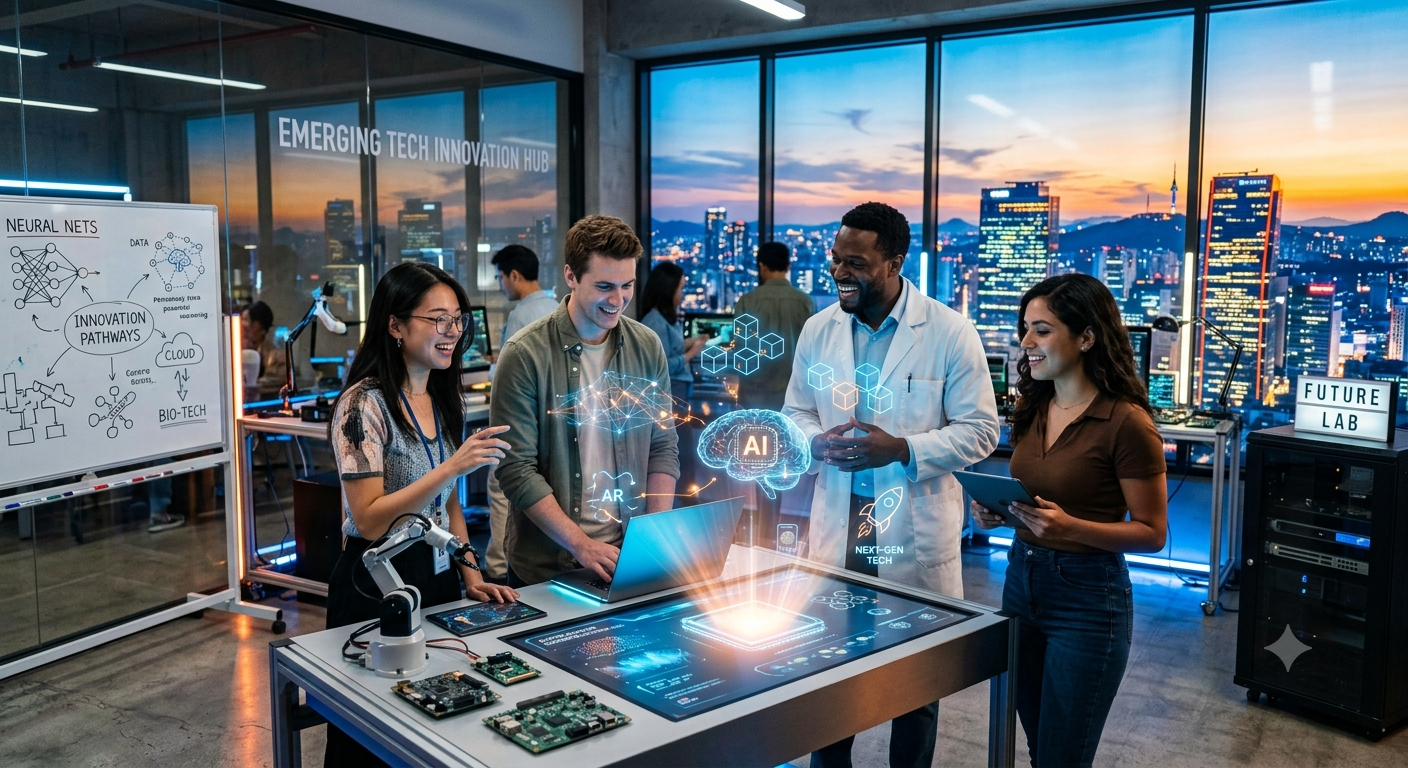
Imagine a world where your computer operating system thinks alongside you, robots handle the heavy lifting in factories, and you can control your digital devices just by thinking.
It sounds like pure science fiction, but according to the latest tech insights, these aren’t distant fantasies. Artificial Intelligence is moving aggressively from isolated experimentation to the core backbone of the global digital economy. We are witnessing a massive convergence of AI, hardware, and biology.
Here are the key technology trends actively shaping our reality—and how they have evolved from early predictions into real-world applications.
1. The Era of “Agentic Reality” (Autonomous AI Agents)
We are moving past simply chatting with AI; we are now delegating entire multi-step workflows to it. Industry leaders officially classify this as Multiagent Systems (MAS)—ecosystems of specialized, modular AI agents that collaborate to solve complex business goals.
- The Reality Check: While a vast majority of enterprises are piloting these systems, the major hurdle isn’t the code—it’s redesigning broken business processes to let autonomous agents do their job. AI software engineers like Devin (Cognition Labs) and autonomous workflows are proving that intent-driven development is here to stay.
2. “Physical AI” (Humanoid Robots & Commercial Automation)
Intelligence is no longer confined to flat screens; it has officially entered the physical world. Humanoid and industrial robots are leaving the laboratory and clocking into work.
- The Proof: Amazon has deployed over a million robots across its network, using specialized fleet AI to boost warehouse travel efficiency by 10%. In manufacturing, Figure AI’s bipedal robots and Tesla’s Optimus are handling repetitive factory tasks, while companies like BMW have integrated autonomous systems directly into production lines.
3. The Generative AI Default & Domain-Specific Models
Generative AI is no longer a novelty; it is the infrastructure for content creation and software engineering. However, generic models often fall short for complex, specialized industries.
- The Shift: Enterprises are aggressively moving toward Domain-Specific Language Models (DSLMs). These are AI models trained and fine-tuned on highly specialized industry data (such as healthcare, legal, or finance). Over half of all generative AI models used by enterprises are now domain-specific to ensure accuracy, compliance, and deep contextual reasoning.
4. Edge AI, Local Processing, and Cloud 3.0
The pressure from global privacy regulations (like Europe’s GDPR and California’s CCPA) combined with skyrocketing cloud data bills has forced an infrastructure reckoning.
- The Strategy: The tech world has moved to a Strategic Hybrid Infrastructure (Cloud 3.0). Heavy model training still happens on massive AI Supercomputing Platforms, but immediate, day-to-day inference is handled locally on-device. Hardware like Apple’s M-series chips, Qualcomm’s Snapdragon X Elite, and Intel’s built-in Neural Processing Units (NPUs) allow laptops and smartphones to act as secure, offline brains.
5. AI-Native Development & “Vibe Coding”
Building software used to require writing endless lines of manual code. Today, the paradigm has shifted from “writing” to “expressing intent.”
- The Impact: With AI-native development platforms, engineers articulate the desired outcome, and AI autonomously delivers, integrates, and maintains the code behind the scenes. This has lowered the barrier to entry so significantly that small, nimble teams can build enterprise-ready tools, giving rise to rapid internal innovation.
6. Personalizing Healthcare with Predictive AI
AI in healthcare has evolved from basic imaging assistance to highly proactive, hyper-personalized medicine. Advanced models (like those from Google DeepMind) are capable of detecting dozens of distinct diseases from simple retinal scans earlier than traditional methods. In modern hospital systems, predictive AI analyzes real-time patient data to flag critical risks like sepsis hours before physical symptoms even manifest, allowing doctors to intervene early.
7. Brain-Computer Interfaces (BCIs) Take Flight
The boundary between human thought and digital action is actively blurring. Brain-Computer Interfaces have successfully transitioned into human clinical trials. Following early breakthroughs by Neuralink enabling paralyzed individuals to control cursors via thought, competitors like Synchron and Precision Neuroscience are scaling less-invasive, endovascular devices. These systems are moving closer to mainstream clinical utility, focusing heavily on restoring mobility and digital communication for patients with severe paralysis.
Inspired by the video [“Top 17 New Technology Trends That Will Define 2026”](https://www.youtube.com/watch?v=Otim2mDjsYM)
Leave a Reply