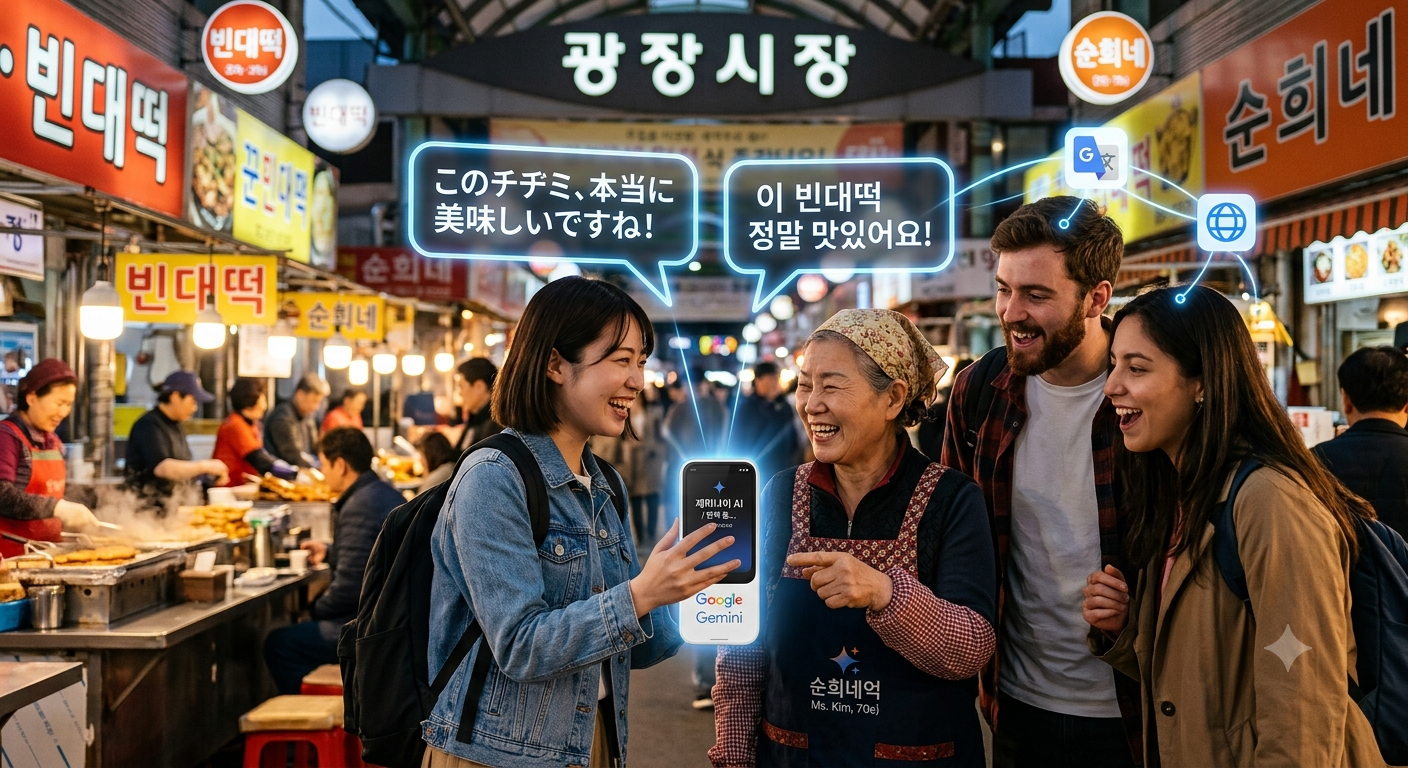
The battleground of the generative AI market has decisively shifted from pure text processing to seamless, multi-modal, real-time voice experiences. Standing at the vanguard of this evolution, Google has unveiled a powerful asset poised to fundamentally restructure the translation landscape: Gemini 3.5 Live Translate, natively integrated into the Google Translate ecosystem.
Rather than functioning as an incremental software update, this release represents a structural leap that redefines the human-to-technology behavioral dynamic during cross-lingual communication. Below is an analytical breakdown of this landmark update across three distinct strategic vectors.
1. Breaking Form Factor Constraints: Seamless Cellular-Style UX
A primary friction point in legacy mobile translation utilities has been the fragmentation of the user experience (UX). Users were traditionally bound to awkward interactions—either passing a screen back and forth or remaining tethered to dedicated wireless earbuds to capture continuous translated streams.
Gemini 3.5 Live Translate systematically eliminates these hardware and behavioral constraints. Users no longer require connected earphones to retain natural translation fluidity. By leveraging proximity sensors and localized audio routing, users can simply raise the smartphone to their ear—simulating a standard telephone call—to receive clear, immediate translated audio output. This elegant adjustment transitions translation from a disruptive tech-mediated event into a socially frictionless, intuitive interaction.
2. Advanced Simultaneous Interpretation: Latency Optimization and Acoustic Mirroring
Technologically, the engine has moved entirely past consecutive translation models (where processing initiates only after a speaker concludes their sentence) and successfully transitioned to a continuous real-time generation framework. Consecutive systems inherently break the cadence, rhythm, and emotional flow of human dialogue.
Google’s new architecture maintains a precise, dynamic equilibrium between immediate translation output and contextual buffer processing to mitigate syntactic errors. Consequently, the latency between the primary speaker’s utterance and the target translated output has been reduced to a mere matter of seconds, approaching the performance threshold of professional human simultaneous interpreters.
This operational efficiency is further augmented by two core technical capabilities:
- Autonomous Language Detection: The system automatically identifies the source language dynamically. This eliminates manual configuration toggles, allowing fluid multilingual dialogue to occur naturally in highly diverse environment settings.
- Acoustic Identity Preservation (Voice Cloning): Moving beyond monotonous, synthesized text-to-speech engines, the model analyzes and replicates the primary speaker’s unique intonation, speaking style, and vocal pitch (tone). The translated audio is generated utilizing these mapped attributes, successfully preserving the emotional nuance and intent of the original speaker.
3. From Consumer Utility to Enterprise Architecture: Ecosystem Expansion
Google’s deployment framework extends far beyond consumer-facing mobile applications. The tech giant has confirmed that this simultaneous interpretation engine will be deployed directly within its enterprise collaboration platform, Google Meet, directly targeting global enterprise communication barriers.
💡 Industry Feedback: > Global media and content production conglomerates have already begun processing the implications. Following initial localized beta testing, Baek Hyun-jung, Chief AI Officer (CAIO) at CJ ENM, stated: “The architecture delivers a level of fidelity and qualitative precision capable of offering an intensely vivid and uncompromised experience to both global and domestic audiences alike.”
The implications for localized corporate operations, transnational web-panels, and cross-border strategic alignments are significant: the frictional expenditures in time and specialized personnel historically required for international interpretation will see rapid contraction.
📝 Tech Comment: Engineering the Invisible Interface
The deployment of Gemini 3.5 Live Translate goes beyond the presentation of an exceptional utility; it serves as a masterclass in Invisible Tech. True technological advancement occurs when the underlying complexity dissolves entirely into the background, leaving only an unencumbered human experience.
A system capable of translating 70+ languages with sub-second scale latencies, while natively preserving individual vocal identities, signals a massive turning point. The traditional geopolitical and economic friction points tied to linguistic divides are evaporating. This structural shifting of the global communication landscape warrants deep strategic observation.
What elements of this architectural shift by Google hold the highest transformative potential for your specific workflows? Let us know your thoughts in the comments below.
- Reference Analysis: YTN News Network Report – “Google Eliminates Foreign Language Barriers with Proximity-Based Audio Translation”
Leave a Reply